We’re presenting at ICSR 2025 in Naples on Wednesday, 10 September 2025 (ICSR 2025)
TL;DR
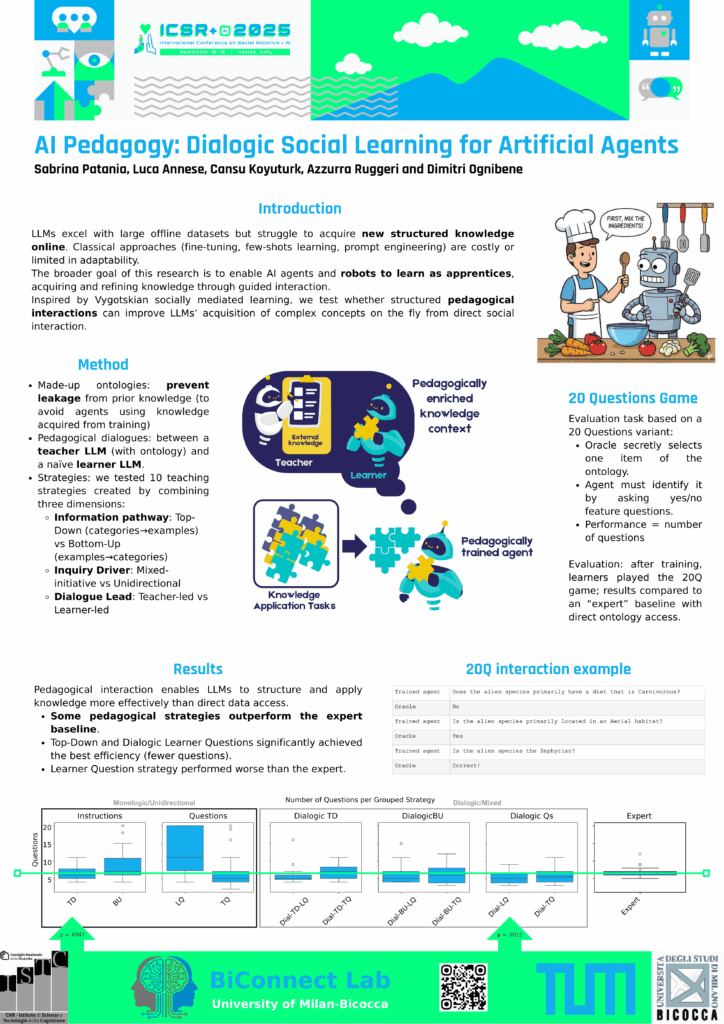
Instead of feeding models ever-bigger datasets, our new paper shows how to teach AI through structured, dialogic interactions—more like mentoring an apprentice than labeling a mountain of data. In controlled experiments, pedagogical dialogues helped a learner model acquire and apply new concepts more efficiently than even an “expert” with direct data access. Read the paper: (arXiv).
Why interactive teaching matters (and why it’s hard)
Building huge datasets is slow, expensive, and often brittle. Real work is fluid: experts explain, question, and adapt on the fly. If AI systems could learn that way—through back-and-forth pedagogy—they’d adapt faster, transfer better, and require far fewer labeled examples.
But interactive teaching introduces challenges:
- Structure: what sequence of explanations and questions best supports rapid understanding?
- Agency: should the “teacher” lead, or should the “learner” drive with questions?
- Direction: are top-down (category→example) explanations more effective than bottom-up (example→category) discovery?
Our paper tackles these questions head-on.
What we built and tested
In AI Pedagogy: Dialogic Social Learning for Artificial Agents (arXiv), we set up an AI Social Gym where a teacher LLM with access to a ground-truth ontology interacts with a naïve learner LLM using different teaching strategies (e.g., top-down vs. bottom-up; teacher-led vs. learner-led; mixed-initiative dialogues). We then evaluate learning with a 20-Questions–style task: the learner must identify a secret item by asking yes/no feature questions; fewer questions = better understanding. To avoid leakage from prior training, we used made-up ontologies.
Key findings (short):
- Pedagogical dialogues beat direct data access. Some strategies outperformed an “expert” baseline that had the ontology outright.
- Top-down & dialogic strategies were the most efficient, cutting the number of questions needed to nail the answer.
In other words: good teaching – the right mix of explanations and questions – helps AI learn new, structured knowledge on the fly.
Why this matters beyond the lab
Across industries, organizations are scrambling to capture and transfer expert know-how as veterans retire and entry-level roles shrink. A few snapshots:

- Japan’s “no new pupils” problem: with an aging workforce and fewer apprentices, firms are using AI to preserve and pass on veteran skills. Hitachi, Meidensha, and NEC are piloting systems that turn tacit procedures into step-by-step guidance and training simulations. (Asia News Network)
- Craft meets AI: in Kyoto’s centuries-old Nishijinori weaving, artisans collaborate with AI to generate pattern suggestions, augmenting human craft where traditional mentorship pipelines are thinning. (AP News)
- Healthcare & knowledge bottlenecks: hospitals and medical schools are adopting AI tools and curricula both to reduce paperwork and to scaffold learning, freeing experts to mentor and making expertise more transmissible. (PBS, CBS News)
- The broader workforce transition: research and industry guidance warn that retiring experts and thinner entry-level paths risk knowledge loss, unless we get serious about systematic knowledge capture and teaching tools. (Deloitte)
Japan’s situation is particularly instructive: demographic pressure is pushing a national-scale shift toward human–AI knowledge transfer, not just automation. That aligns with our core thesis: teaching-centric AI can help societies sustain capability when human apprentices are scarce (Le Monde.fr).
How our approach helps
Our results suggest that pedagogically structured, mixed-initiative dialogues (top-down explanations plus targeted learner questions) are a practical recipe for operational knowledge transfer. Think onboarding a service robot to a new store layout, briefing a diagnostic assistant on a hospital’s local protocols, or capturing a retiring engineer’s troubleshooting playbook.
Concretely, this means organizations can invest in pedagogical agents that:
- elicit key concepts and decision rules from experts,
- sequence explanations for rapid learner uptake, and
verify understanding through dialogic questioning—without assembling massive new datasets first.
See us in Naples!
We’ll present this work at ICSR 2025 (Naples), Wednesday, 10 Sept 2025 (LinkedIn post). If you’re at the conference, come say hi—we’d love to talk about applying dialogic teaching to your robots and AI tools.
Stay tuned!