We’ll be at the 2025 IEEE International Conference on Development and Learning (ICDL), hosted by CTU in Prague on Sept 16–19.

What we’re showing
Robot Learning Theory of Mind through Self-Observation: Exploiting the Intentions–Beliefs Synergy
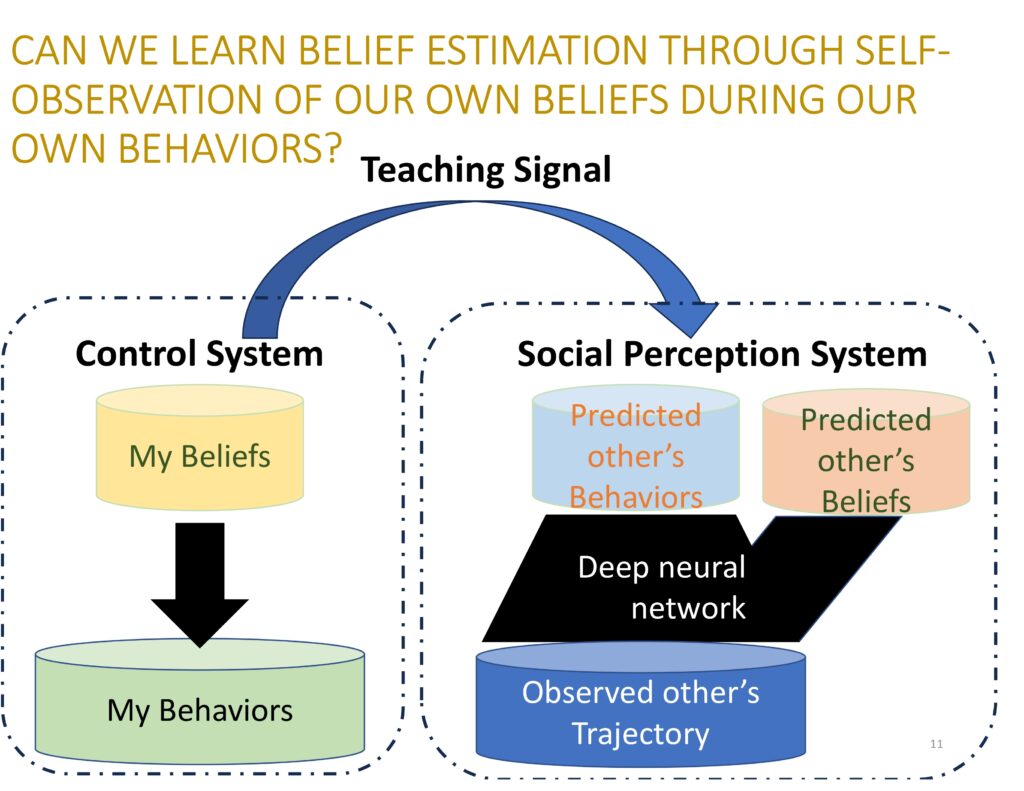
Francesca Bianco & Dimitri Ognibene — presented as a spotlight + poster. The short paper distills our approach: teach a robot to read others’ goals better by jointly learning intentions and beliefs, using the robot’s own control/belief traces as supervision (“self-observation”).
The gist
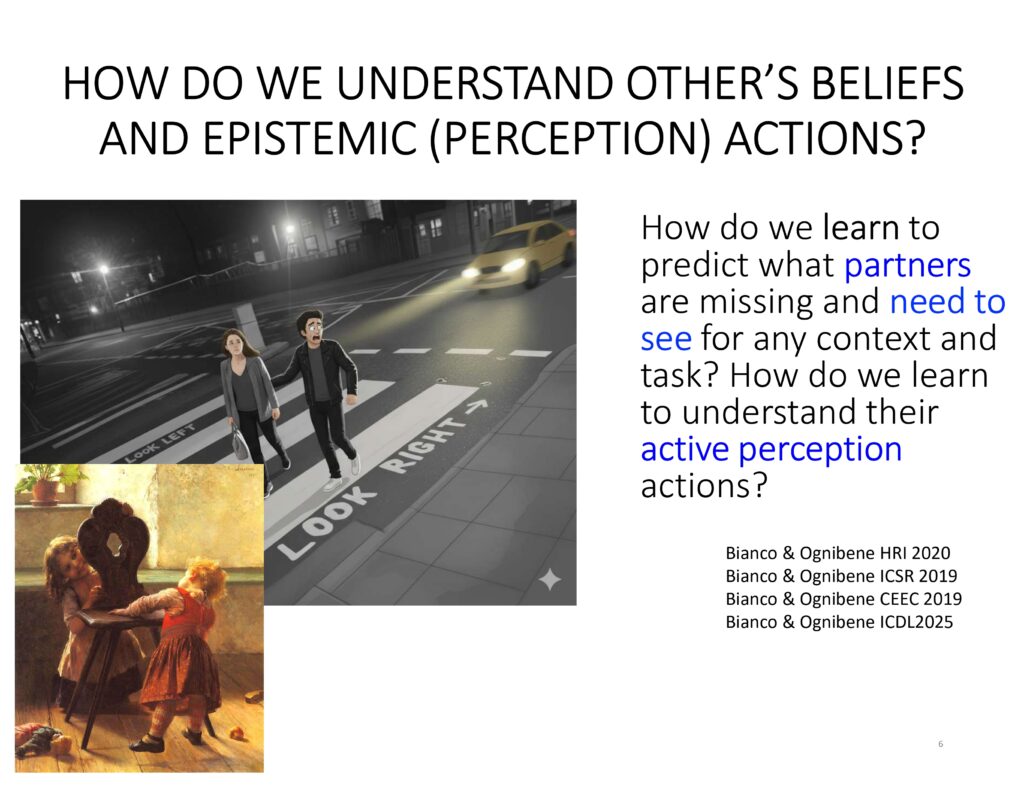
When targets are hidden or scenes are cluttered, behavior is driven by beliefs (what the agent thinks is true). If our model learns to predict beliefs and intentions together, it becomes better at guessing the goal from a short trajectory. In our earlier experiments this yielded:
- a small but consistent overall boost in target prediction (about +1.9 pp at mid-size training sets),
- a bigger jump when the target isn’t visible (about +7 pp), and
- the largest gains in hard clutter (aligned distractors: up to +12.8 pp, ~30% relative).
Under the hood, it’s a Social Perception System (SPS): a shared network with heads for next action/state/target—and a belief-map head trained from self-observation; multi-tasking acts like a helpful regularizer.
Why it matters (the one-minute version)
- Beliefs help intention prediction. When we add a belief-prediction head to the network, overall target-prediction accuracy improves consistently once there’s a modest amount of data (e.g., +1.9% at 25 maps; peaks around +1.8–1.9% across mid-size datasets).
- Big gains in the hard cases. Under hidden-target conditions the joint model improves accuracy by ~7 percentage points; with distractors aligned with the future path we see improvements up to ~12.8 points (≈30% relative in that setting).
- Trains on self, generalizes to others. Models trained from an agent’s own belief/decision traces transfer to agents with different decision policies while preserving the joint-learning benefit.
Come find us
ICDL schedules poster spotlights followed by poster sessions each afternoon—check the program on site for exact slots and location at CTU-FEL. We’d love to talk! (icdl2025.fel.cvut.cz)
Additional Material
Slides
Poster
Acknowledgments
Supported by the Volkswagen Foundation project “Developing an Artificial Social Childhood (ASC)”.